Working Dog Wonders and its Continuity

Conservation Lower Zambezi (CLZ) is a grassroots NGO based in the Lower Zambezi, working alongside the local wildlife authority – the Department of National Parks and Wildlife (DNPW), to protect the incredible wildlife of the area.

While the fast-paced nature of wildlife conservation caught up to CLZ in July of 2019 when the organization sadly lost one of its tracking and detection dogs, we were fortunate to receive multiple grants dedicated to the continuity of the CLZ/DNPW K9 Unit, allowing the purchase of two new dogs, the recruitment of a kennel keeper and a third handler, the procurement of new specialized equipment and the expansion of the kennels at the CLZ Basecamp.

On 11th March our two new working dogs will arrive in Lusaka and after months of organization and preparations, we can finally welcome our new chosen stars.

Invictus K9, the organization brought in to do the selection and training course, went to the Netherlands to test and assess multiple dogs and they have made their final decision...Meet Kalo and Amor, two beautiful pure bred Malinois.

Kalo and Amor will be trained as detection dogs to find ivory, rhino horn, bush meat, ammunition, firearms, cat skins and pangolins, which will help us immensely in our fight against poaching and the illegal wildlife trade.

 Over the last few months we have been working hard at CLZ to extend our kennels and make sure the dogs will be safe and comfortable in their new accommodation. We are still doing final touches now, but everything will be ready for them when they arrive at their new home in the Lower Zambezi.

CLZ can’t express the level of excitement for the two new dogs and the continuation of the specialized and strong forced K9 Unit. This K9 Expansion is funded by IUCN Save Our Species, co-funded by the European Union, Lion Recovery Fund, the International Elephant Foundation and the Berry Family Trust and Adrian Scripps. Thank you to these donors for their rapid response in allowing CLZ to continue the fight against wildlife crime. Without donors such as these, CLZ would not be able to have this impact on the conservation of the incredible Lower Zambezi.
 

ICUN SOS EU

This publication was produced with the financial support of the European Union through IUCN Save Our Species. Its contents are the sole responsibility of Conservation Lower Zambezi and do not necessarily reflect the views of IUCN or the European Union.


CLZ Statement on the Proposed Mine in the Lower Zambezi National Park


26th October 2019

OFFICIAL STATEMENT FROM CONSERVATION LOWER ZAMBEZI ON THE PROPOSED KANGALUWI OPEN-CAST COPPER MINE IN THE LOWER ZAMBEZI NATIONAL PARK

Conservation Lower Zambezi (CLZ) is a non-profit organisation that works with the Department of National Parks and Wildlife (DNPW) under the Ministry of Tourism and Arts, to protect the wildlife, habitats and ecosystem of the Lower Zambezi. These assets are of local, national and international importance and need to be protected for future generations.

CLZ understands that mining has a place in Zambia's economy, however, based on the documents which have been made publicly available, CLZ is deeply concerned about this mine's potential impact on the nation’s conservation status and the environmental threat it poses to the renewable resources ofthe ecosystem.

The LZNP is an area of international conservation significance, supporting one of the most important populations of African elephant in the region, in addition to many other species. There is substantial connectivity between the LZNP and South Luangwa National Park, it lies opposite a UNESCO World Heritage Site (Mana Pools National Park, Sapi and Chewore Safari Areas in Zimbabwe) and is in the process of being registered as a Transfrontier Conservation Area.

Eco-tourism in the area depends largely on the renewable wildlife and habitat resources and contributes significantly to the local and national economies around the LZNP. With three other parks, tourism in LZNP generates 96% of the income the DNPW raises for wildlife management in the country. Tourism establishments in the park and surrounding Game Management Areas (GMAs) employ more than 1,000 local people, generating a local wage bill of $4 million annually that indirectly supports thousands more people at a local community level. The reputational damage that Zambia and the region would suffer by allowing mining in a national park will definitely impact on tourism in this flagship area.

Local communities depend on the area’s renewable resources in fishing, agriculture, tourism and forestry. All of these resources could be significantly impacted by a mine, particularly aquatic resources. River pollution caused by the mine could threaten the Zambezi river’s 2,000 ton subsistence fishery, which provides food and protein security to 20,000 people along the river’s banks.

The mine also threatens upcoming conservation projects such as the $12.5 million dollar Lower Zambezi Flagship Species Restoration project, which received approval from the Ministry of Tourism and Arts in 2018. The project aims to bring back locally extinct species such as the black rhino and eland, thereby restoring biodiversity and improving ecosystem processes.

We join all our local and international stakeholders in issuing a call on the Government of The Republic of Zambia to reconsider and revoke the permission to mine the Lower Zambezi, thereby jeopardising a renewable, sustainable asset of local, national and international importance.

Lego: 3rd February 2014 – 22nd June 2019

It is with a heavy heart that CLZ report the death of Lego – one of our detection and tracking dogs in the CLZ/DNPW Dog Unit, who died on Saturday 22ndJune 2019 from poisoning. The case is being taken very seriously and samples are being analysed and investigations carried out to determine whether it was intentional or accidental.

Lego was an exceptional working dog and a big part of the CLZ team since 2016 and has contributed to about 108 operations and to the apprehension of 82 poachers and the confiscation of 12 pieces of ivory, 40 firearms and 960kgs of bushmeat.

CLZ would like to acknowledge and thank Dr. Liza Oparaocha and her assistants for their tireless efforts giving Lego the best chance of survival that he could have gotten and to Dr. Ian Parsons for his expert opinions and support.

It is a great loss for CLZ, DNPW and our efforts within the Lower Zambezi and for the handlers who have spent three years with Lego, taking care of him and working alongside him.

How Protecting Wildlife Changed One Man’s Life

Elephant Crisis Fund have been a generous donor to CLZ contributing vital funds to assist with setting up the Dog Unit and now the Rapid Response Unit. In order to shine a light on some of the great work that they have contributed towards, the organisation chose to do a story about one of CLZ's very own - Peter Tembo, the leader of the K9 Unit. This wonderful story has reached numerous people across the world and has even been 're-grammed' by Leonardo DiCaprio.

December 10, 2018

Meet game ranger, Peter Tembo and his dog, Lego.  We can’t show you their faces for security reasons but Peter is the head of the successful ECF-funded Zambian Department of National Parks and Wildlife (DNPW) and Conservation Lower Zambezi (CLZ) detection and tracking dog unit in Zambia, while Lego is his trusted four-legged partner.

Sniffer dog units are an essential tool in combatting wildlife trafficking and poaching. The highly trained DNPW/CLZ unit searches trafficking ‘hotspots’ for ivory, pangolin scales, rhino horn, bush meat, cat skins, firearms and ammunition in areas surrounding the Lower Zambezi National Park.

Since the two-dog, four-handler unit was formed in 2016, the team have successfully confiscated a high number of illegal wildlife product from poached bush meat to illegal ivory and arrested many suspects. Most of the product has been found in vehicles, at border posts and in local communities, including Peter’s former village.

Being head of such a specialised unit in a small community is not a job for the faint-hearted. For this role you have to be tenacious, thick-skinned, calm and above all, a strong leader. Fortunately Peter possesses all these qualities and more. Thanks to the special bond he has with his partner, Lego, and the dedication of his entire team, the K9 unit has been able to efficiently and quickly locate illegal objects and help deter wildlife crime in the area.

But Peter’s life hasn’t always been this promising. Eight years ago, he was living in the local village without a job, no money and a grim future. Peter’s dreams of a greater life seemed unattainable until a chance encounter in 2010, while working as a casual labourer on a road near Conservation Lower Zambezi, changed his life.

Offered a job as a porter in the Conservation Lower Zambezi’s kitchens he spent the next six years steadily climbing up the ladder working as a camp assistant and operations assistant before being selected for the dog unit as its leader. As part of his selection process he underwent a gruelling 3-6 months military and basic ranger training. The dogs were trained by Invictus K9.

“I always knew he would succeed,” says CLZ’s CEO Ian Stevenson, who encouraged Peter to apply for the K9 leadership role. “Peter has the integrity, he’s a great leader, a hard worker and it’s been fantastic to watch him grow over the years. “

Marine Unit


 For Peter, it’s been an interesting, challenging and rewarding journey. Before he became head of the CLZ dog unit, Peter had little regard for animals. Elephants were nothing but a pest that damaged his livelihood and killed local people, while dogs were just ‘stupid scavengers’. Eight years on, his attitude has completely changed.

“Before this job I didn’t understand why people would want to protect elephants. I thought they were just pests and should be killed. But now, as a wildlife officer and dog handler, I understand their value. I also had no idea dogs could be so clever. And I never imagined they could ever find ivory!”

Of course there have been challenges and due to the sensitive nature of his work Peter was forced to leave his local village and move his family - a wife and young daughter - to the safety of a larger town near Lusaka. “I can no longer live in my community as there are people who work illegally there and they know my line of work. It would be dangerous for me and my family to remain. But there has been a lot of sensitisation work done in the community and things are starting to change. We even now get reports from locals about strangers in the park with firearms which never happened in the past.”

Ian Stevenson has great faith in his protege and says he’d one day like to see Peter gain international experience working with other dog units around the world. “Peter’s skills are so strong and I know he’d do well. At the moment his Invictus 9 qualifications are only recognised nationally. We’d love him to also have international qualifications in dog handling. He’s a real asset to our organisation.”

As for Peter - he says he can’t imagine what his life would be like had he not been discovered by CLZ and met Ian. “My life has completely changed. The passion I have for wildlife is what keeps pushing me to never give up this work.”

The DNPW/CZL K9 unit is managed through a partnership between Conservation Lower Zambezi and the Zambian Department of National Parks and Wildlife and part funded by USAID, United States Fish and Wildlife Service (USFWS), and the Elephant Crisis Fund.

Education for a New Generation

This year, under an MoU between CLZ and UNZA, we were able to bring in an intern to assist with our Environmental Education Programme. The bright and capable Eglina Mpanga joined us from Lusaka for a month and has enthusiastically immersed herself into the camp lifestyle. Eglina is in her 3rd year of university, pursuing a Bachelor’s degree in Environmental Education at UNZA.

Read Eglina’s blog about her background and her experience at CLZ:

Since grade one, I have been exposed to the topic of conservation as I joined the conservation clubs and stayed in it until I completed secondary school. I grew up in a Game Management Area, that also influenced my passion towards conservation. While growing up, I had no idea there were courses related to conservation being offered in Zambia, because environmental related programs were poorly advertised, thus I had other ambitions despite my passion for the environment.

Circumstances drew me back to my true passion in 2015, when I was given admission to study Environmental Education at the University of Zambia. Because of the knowledge I had from my experience from the conservation clubs, the course felt just right. Environmental Education is a course that looks at the environment in totality from the ecosystem, society, politics and the economy. I am interested in what I am studying because it covers so many important topics.

In November this year, I saw an advert that Conservation Lower Zambezi was looking for an intern to work with them for one month under the Department of Environmental Education. Environmental education being my passion, I applied with all faith that I would be given the internship space, and once awarded the position, I was very excited to finally visit the Lower Zambezi for the first time and put my skills and knowledge into action.

When I arrived, the thought of having no mobile network made me think that my stay would be terrible, but instead beautiful scenery awaited me. Conservation Lower Zambezi being located in the midst of the bushes means that animal encounters are not a strange story…but to me they were! One evening, I was going to the dining area from my room and I heard footsteps and thought it was a person, so I got closer and guess what I saw? A hippo! At that moment, I did not know whether to stand still or run. I waited until it went away then I exercised my athletic skills.

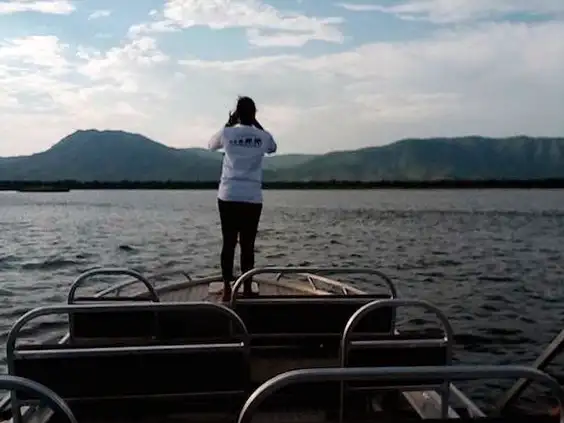
Up to now, I had only been into one national park in Zambia, South Luangwa National Park. Visiting the Lower Zambezi National Park for the first time was more than awesome. Including the game drive into the park, the boat cruise I went on was something I could have never imagined. Viewing the escapement from the mighty Zambezi River, got me thinking what beauty Zambia has.

I was exposed to the complexities of data analyses through my duties, which is something I was not taught in school, and it opened my eyes to the important issues I never knew about wildlife conservation. Not only has working with and learning from Besa inspired me to acquire more knowledge about wildlife, it has also given me the confidence to work extra hard and educate people on the need to conserve nature and the benefits that comes with doing so.

After completing my studies, I would like to work with organizations within Zambia whose mission is to perfect the wellbeing of the environment.